

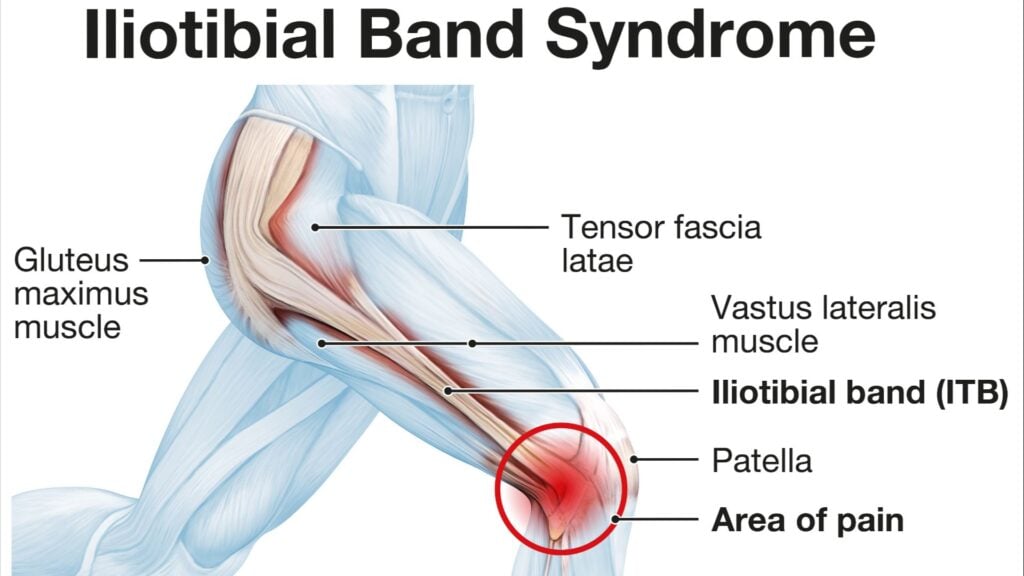
The tensor fascia latae (TFL) muscle and iliotibial (IT) band work together to help you move your hips, knee, and pelvis. Iliotibial band syndrome is an injury to your TFL and IT band and is commonly seen in runners, but cyclists and rowers may develop IT band syndrome, too.
Fortunately, the prognosis is good, and IT band syndrome responds well to chiropractic treatment. Here’s everything you need to know about TFL and IT band syndrome, and what to expect when seeking chiropractic care.
What Are the Tensor Fascia Latae and Iliotibial Band?
The TFL and IT band are different parts of your thigh muscles that work together and allow your lower body to move, bend, and stretch in every direction.
The IT band is the long tendon that runs along the outside of your leg. It starts at the top of your pelvic bone and goes down to your knee. The tensor fascia latae is inside the IT band. It’s a small muscle on the front of the hip that works with other gluteal muscles, helping you move and bend.
As an example, the TFL muscle and IT band work together in a motion called hip flexion, something you do when you walk, run, or sit. Essentially, hip flexion allows you to bring your thighs and knees to your chest. Knee flexion is similar in that the TFL and IT band work together to help you bend your knees.
What Is Iliotibial Band Syndrome?
Iliotibial band syndrome can happen in one or both of your legs. When the IT band becomes irritated and inflamed, you’ll feel outer knee pain. In many cases, IT band syndrome happens due to overuse from running and cycling, and is more likely to occur when you’re on an uneven surface or going downhill.
Common Causes of IT Band Syndrome
When the IT band is stretched too tightly, it rubs against your bones. This can happen due to:
- Overpronating your feet. Your feet naturally pronate when you walk. As your foot strikes the ground, it rolls inward, helping distribute your weight evenly and absorbing the shock. Overpronation occurs when your foot rolls inward by more than 15 degrees, which can stress the inner arch of your foot.
- Bowed legs. Some people are born with bowed legs. Their knees curve out, and the feet and ankles touch. While most children grow out of it, that’s not always the case. Bowed legs can create friction and stress in the knee, thigh, and IT band.
- Weak hip abductor muscles. The TFL muscle is part of your hip abductor muscles, which also include your gluteal muscles. Weakness in these muscles can contribute to IT band syndrome.
- Different leg lengths. When your legs are two different lengths, you’re more likely to have an uneven gate or poor posture. Over time, this can put stress and friction on the IT band.
Common Symptoms of IT Band Syndrome
Most people with IT band syndrome will experience pain on the outside of their knee, some people feel pain on the inner knee, and others may only have pain in their thigh. Other IT band symptoms include:
- Pain that gets worse after running, especially when running on an incline.
- Pain after climbing stairs or hills
- Being pain-free until you exercise, particularly knee or thigh pain in the affected leg that starts in the middle of a run
- Pain that accompanies a snapping hip
- A squeaking noise when bending or straightening your knee (rare)
How Can Chiropractic Improve IT Band Syndrome
Current evidence suggests that iliotibial band syndrome responds best to conservative treatment, including manual therapy like chiropractic adjustments. However, it’s best to wait at least a week from the onset of IT band symptoms before seeking chiropractic care. During that week, you should rest your TFL and IT band to allow them time to begin the healing process.
TFL and IT band chiropractic focuses on restoring flexibility and stability in your hip flexors to strengthen the tfl muscle and restore hip mobility. Your provider may also recommend deep tissue massage to release muscle tension through the hip flexors and stretching exercises to rebuild strength throughout your TFL muscle and prevent a recurrence.
Flourish Chiropractic Spa Can Ease Your Pain
No matter why you’re experiencing IT band syndrome, the caring, compassionate team at Flourish Chiropractic Spa can help ease your pain. Our practitioners and massage therapists can restore flexibility and movement in your hip flexors, reduce strain and tension in your muscles, and help you get back to doing the activities you love.
