
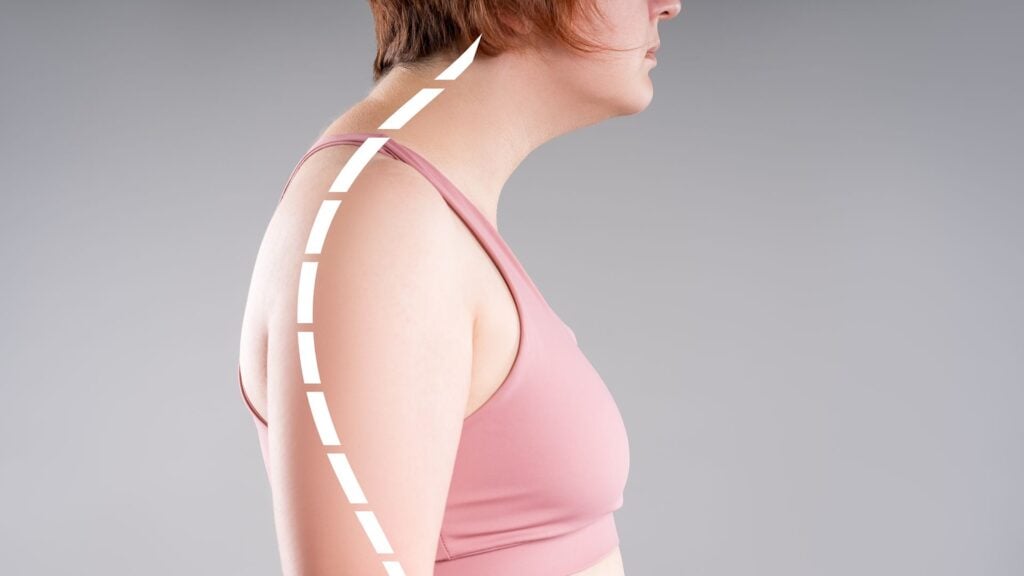
Perhaps you’ve noticed your posture is changing. It feels like you’re not standing up like you used to, or your neck seems tight all the time. Maybe you’ve looked at your profile in the mirror and caught glimpses of what seems to be a hump between your shoulders or around your neck.
The change may be concerning, but it doesn’t mean you’re turning into Quasimoto. It’s possible what you’re seeing is a dowager’s hump, a structural change to your spine that can impact how you move, function, and feel. And depending on the cause, chiropractic care can help improve your dowager’s hump.
What Is Dowager’s Hump?
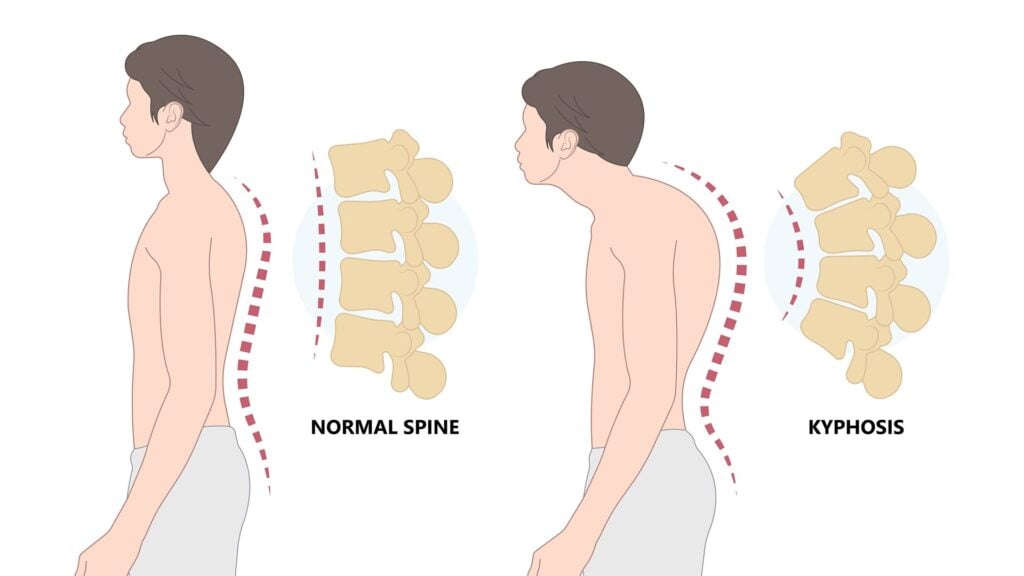
Your spine is naturally curved in an S shape, which helps your body absorb shock (like when you run or jump), support your weight, and allows you to maintain your balance. In some people, though, the top part of the spine has an abnormal curve forward. This is known as kyphosis.
A dowager’s hump is a localized form of kyphosis, sometimes called hyperkyphosis. As your spine rounds forward, it creates a structural change in your spine and vertebrae (the bones within your spine), resulting in a bulge or hump at the base of your neck.
Dowager’s Hump Causes
The most common cause of a dowager’s hump is poor posture, like when you slouch or hunch over a keyboard or a screen in your lap. While you can develop a dowager’s hump at any age, it’s most common in middle-aged women.
Other possible causes of a dowager’s hump are:
- Osteoporosis. Osteoporosis is a general weakening of your bones. In the case of a dowager’s hump, you may have compression fractures in several vertebrae (the bones in your spine). These bones start to compress into a wedge shape, forcing your upper back to curve more forward.
- Age-related joint degeneration. Some joint degeneration is normal with age. For example, the discs in your back may not be as flexible as they once were, and they start to collapse forcing your spine into a different posture. You could develop osteoarthritis, which wears away the cartilage in your joints, causing stiffness and pain that make it harder to stand up straight, which, in turn, causes a dowager’s hump.
- Genetics. It’s rare, but some people are genetically more prone to develop a dowager’s hump.
Another possible cause of a dowager’s hump is muscle weakness. Strong back and core muscles help keep you upright, but with age, inactivity, or even an accident, they may weaken. As that happens, those muscles aren’t as able to help you stand up straight, making it difficult to avoid slouching, which can result in a dowager’s hump.
However, a dowager’s hump may be the cause of your muscle weakness. Say you develop a dowager’s hump due to osteoporosis. This changes your posture and body mechanics. As your spine rounds forward, you may adjust how you hold your head or arms to account for the posture change, even if you don’t realize what’s happening. As that happens, new muscles step in to support your head, arms, and neck while other muscles weaken because you aren’t using them as much.
Over time, you end up locked in an endless struggle: the weak muscles have trouble helping you stand upright, causing you to slouch more, which makes your upper back curve more, which changes how you stand, which weakens your muscles.
Common Symptoms of Dowager’s Hump
The most visible signs of a dowager’s hump are a rounding at the base of your neck and arms that hang in front of your body, not at the sides. However, the warning signs you’re developing a dowager’s hump may be evident long before the hump appears.
For example, you may experience pain or stiffness in your back and shoulder blades as your posture changes, and you place more demand on those muscles. Your shoulders may look more rounded and your arms are pulled forward, which stresses your rotator cuffs and causes pain in the elbows or wrists, like carpal tunnel syndrome or tennis elbow.
The curving also places demands on your head and neck. It’s natural to want to look in front of you and not down, so your neck and shoulder muscles compensate. You look ahead, but those muscles work a lot harder to make that happen. Over time, this forward posture can compress the muscles at the base of your skull, causing jaw pain and headaches.

Other Dowager’s Hump Symptoms
Advanced cases of dowager’s hump can change how your chest and upper abdomen are positioned, which may cause digestive and breathing problems.
When you stand upright, your ribs expand as you inhale and contract as you exhale. But when you’re hunched over due to a dowager’s hump, your rib cage is more forward and down. That change means there’s less space in your torso for your lungs to expand, which often means you take more shallow breaths. To be clear, a dowager’s hump doesn’t damage your lungs. It makes it harder to take deep breaths.
Dowager’s hump can also impact your digestion. Because you’re hunched forward and your rib cage is in a different position, there’s less space between your chest and abdomen, which can put abnormal pressure on your stomach. This can cause gastroesophageal reflux disease (GERD), discomfort when you eat, or difficulty swallowing.
Dowager’s Hump vs. Buffalo Hump
A dowager’s hump is often confused with a buffalo hump because they both appear as a hump at the base of your neck. However, a buffalo hump and a dowager’s hump are two different things, though it is possible to have both.
The most important difference between a dowager’s hump and a buffalo hump is that a dowager’s hump is a structural change in your spine. A buffalo hump is a dense accumulation of fat that’s generally caused by metabolic or hormonal changes, though some medications can cause a buffalo hump.
If you’re not sure if what you have is a dowager’s hump or a buffalo hump, there are a few things you can check.
A dowager’s hump is in your upper back. It feels firm and bony, and is accompanied by chronic back or neck stiffness. The hump is visible when you slouch but, depending on the cause, the hump may appear less obvious when you stand up straight.
A buffalo hump appears at the base of your neck. It feels soft and spongy and doesn’t go away no matter how straight you stand.
Can You Prevent a Dowager’s Hump?
While you may not be able to prevent certain age-related changes to your spine, building back strength and maintaining good posture go a long way toward preventing a dowager’s hump from forming.
The more time you spend slumped, slouching, or looking down, the more you’re forcing your neck and spine into a more forward position. Over time, this posture increases pressure on your spinal discs and neck muscles, which damages the structure of your upper back and its ability to hold a normal curve.
Can You Reverse or Fix a Dowager’s Hump?
In some cases, you can reverse a dowager’s hump, but it depends on the cause.
When the cause is poor posture and weak upper back muscles, strengthening the muscles and improving your ergonomics may reverse a dowager’s hump. But when it’s caused by structural changes, it’s unlikely you can fix a dowager’s hump. However, strengthening the muscles can reduce any pain you’re experiencing and improve your posture and place less stress on your muscles.
Can a Chiropractor Fix a Dowager’s Hump?
Chiropractic treatment alone won’t fix a dowager’s hump. But when combined with exercise or physical therapy, manual chiropractic adjustments may be an effective therapy that can improve the curve of your spine.
A chiropractor may perform myofascial release to address any muscle tightness you’re experiencing in your upper back, shoulders, or neck. Chiropractic adjustments can relieve stiff vertebrae and help restore movement and flexibility in your spine. Other supportive therapies, like giving you ergonomic advice or a medical massage, can also improve how you feel and function.
Supportive Therapy for Dowager’s Hump
Chiropractic can be an effective supportive therapy for your dowager’s hump. Paired with exercise and ergonomic changes, chiropractic can improve how you look and feel, and reduce any pain your dowager’s hump may be causing.
If you have a dowager’s hump, buffalo hump, or any kind of neck hump, schedule your free consultation at Flourish Chiropractic Spa today. Our team will devise a personalized treatment plan that will help you stand taller and alleviate your pain.
